
Rhea Care, Egg Incubation & Chick Raising Guide
Rhea Care and Husbandry
Reliable information about raising rheas can be extremely difficult to find. Much of the information available online groups rheas together with emus or other ratites, even though they can differ greatly in personality, nutrition, behavior, incubation, and chick care.
The information shared throughout this guide comes from our own experience raising, breeding, incubating, and hatching rheas for over a decade. It explains what has worked for us and what we have personally observed within our flock.
Every bird, environment, and situation can be different. Our goal is not to claim that there is only one correct way to raise rheas. We want to share the practical knowledge we have gained over the years to help new and experienced owners better understand these unusual birds.
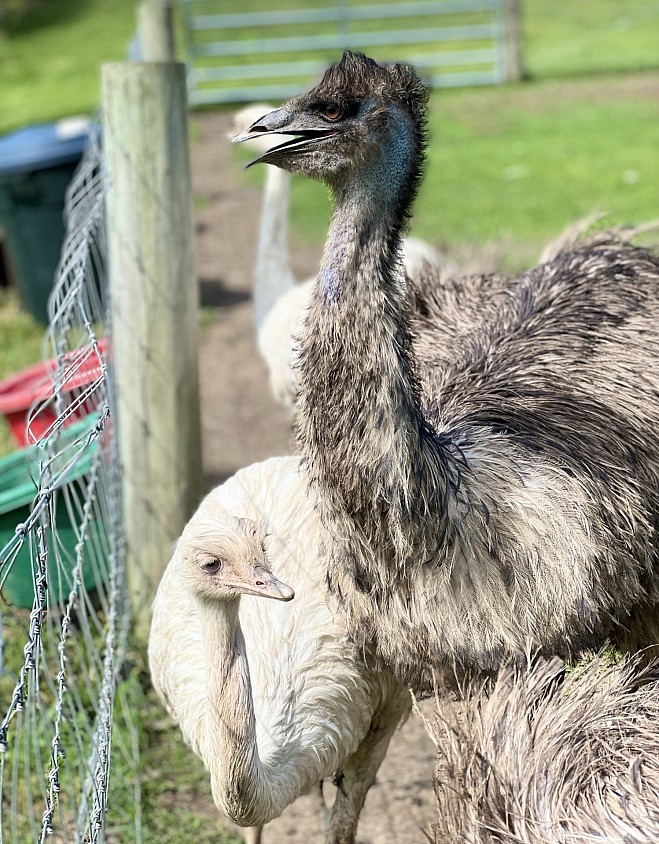
Rheas Are Not the Same as Emus
Rheas and emus are often grouped together simply because they are both ratites. However, in our experience, they do not have the same personalities or husbandry needs.
Emus are often friendly, curious, and more likely to seek attention from people. Rheas tend to be much more standoffish. They may become comfortable with their regular caretakers, but most do not seek affection or human attention in the same way an emu may.
Rheas should not be purchased with the expectation that they will behave like oversized pets. Even when hand raised, they may prefer to keep their distance and interact on their own terms.
We have also found that rheas require a higher protein diet than emus, particularly while they are young and growing. Their feeding program should be planned specifically for rheas rather than assuming that an emu diet will meet all of their needs.
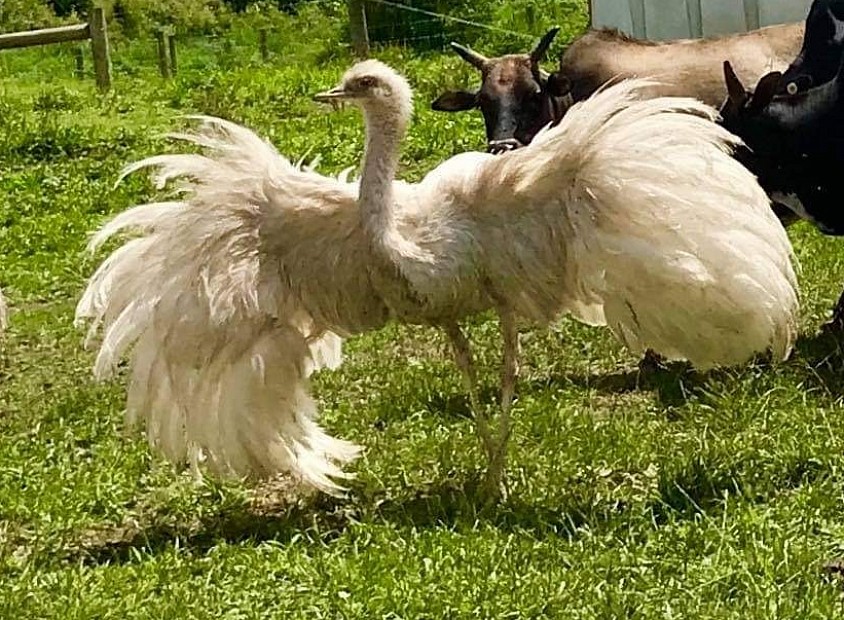
Rhea Behavior
In our experience, rheas do not kick at people in the same manner commonly associated with emus. However, they are still large, powerful birds and should always be treated with care and respect.
Rheas generally respect secure fencing better than emus. This does not mean that poor or damaged fencing is safe. Fences should still be strong, visible, free of sharp edges, and tall enough to securely contain adult birds.
The most difficult behavioral changes are usually seen in males when they reach breeding age and their hormones begin to rise. A male that was previously calm may become territorial or aggressive during breeding season.
Hormonal males may:
● Guard their enclosure
● Protect a nesting area
● Chase people or other animals
● Lower their head or spread their wings
● Become less predictable around gates
● Protect eggs or chicks
Owners should never assume that a male will remain gentle simply because he was hand-raised. Breeding-season behavior should always be taken seriously.
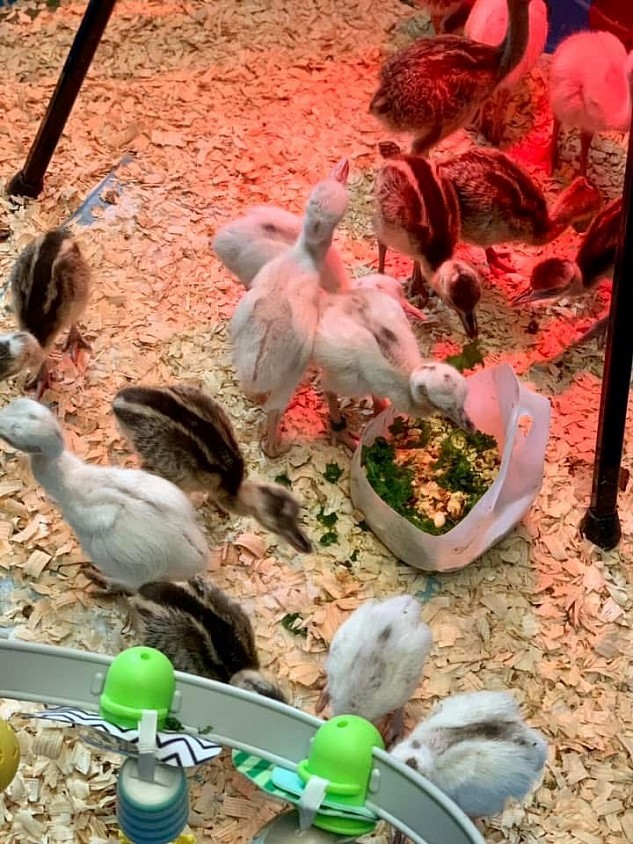
Feeding Rheas
What Works for Our Farm
There are many different opinions about feeding rheas, and experienced breeders may use programs that are very different from ours.
This is the feeding program that has worked for our birds under our farm conditions:
Our feeding program:
Newly hatched
Scrambled eggs, finely crushed eggshell, and kale
Beginning around day three
Non-medicated all-flock starter, mealworms, and scratch grain. Along with leafy greens.
Beginning around two months
Existing chick mixture with high-protein, small bite puppy food added. Leafy greens.
Beginning around six months
Scratch grain, corn, and high-protein adult dog food
Winter
Adult mixture with alfalfa pellets added
Before and during breeding season
Adult mixture with layer pellets added
We share this information because reliable, practical rhea husbandry advice can be difficult to find. It reflects over a decade of our own experience, but each breeder should observe their birds carefully and make decisions based on their flock, feed availability, environment, and veterinary guidance.
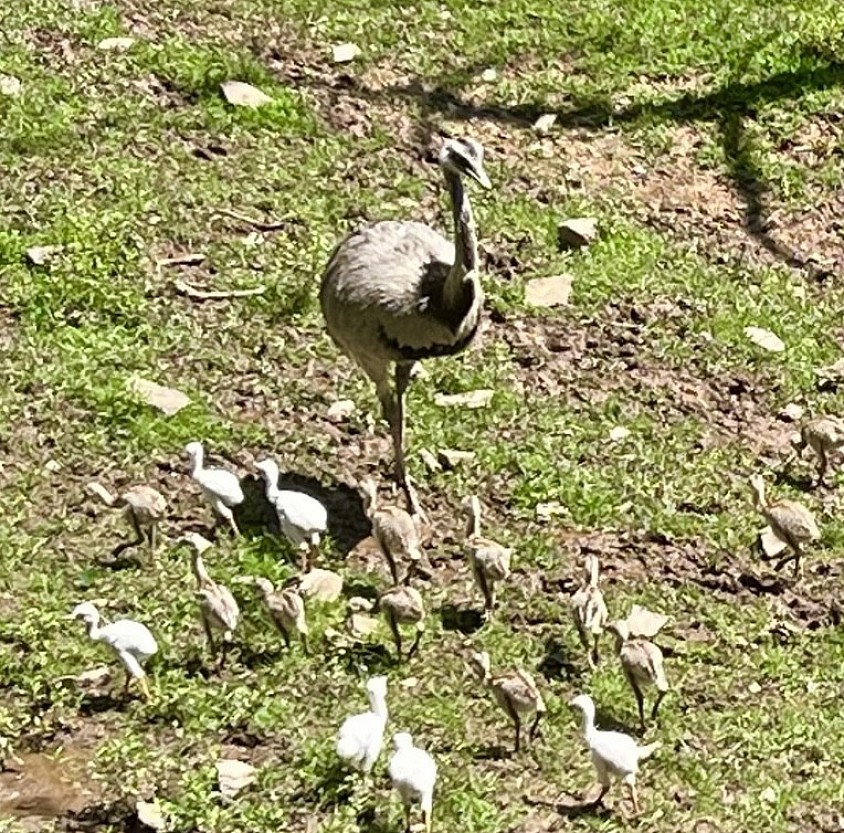
Rhea Nesting and Natural Incubation
Male rheas are responsible for building the nest and naturally incubating the eggs.
During breeding season, the male will select or prepare a nesting location. Females lay their eggs, and the male gathers the eggs into the nest. He then sits on the eggs and may become very protective of the entire nesting area.
The male is also capable of hatching and raising the chicks. This natural paternal behavior is one of the most interesting parts of keeping rheas.
Owners should use additional caution around nesting males. A male that is normally manageable may not allow people near his nest, eggs, or newly hatched chicks.
Hatching as a Clutch
One of the most fascinating things we have observed is the way rhea chicks coordinate their hatch.
The eggs in a natural nest are not always laid on the same day. Even so, an egg that was laid or began developing later may hatch several days—and sometimes close to a week—earlier than its expected individual hatch date so that it can emerge with the rest of the clutch.
As the chicks get close to hatching, they begin calling and communicating with one another from inside their eggs. These sounds appear to help synchronize the hatch so the chicks emerge within a much closer period of time.
This is especially important in a naturally incubated nest because the male needs the chicks to hatch close together. Once the majority of the chicks have emerged, he will eventually leave the nest to begin caring for and leading them. Coordinating the hatch helps prevent younger eggs from being left behind.
From our experience, this means an egg should not automatically be considered unusually early simply because it hatches before its calculated due date. When incubated with other rhea eggs, the developing chicks may adjust their timing to hatch together as a clutch.
Our Rhea Egg Incubation Method
*Rhea Eggs May Hatch Earlier Than Expected*
Rhea hatch dates are not always exact, particularly when several eggs are incubated together.
In our experience, even an egg that was set later than the others can sometimes hatch several days and occasionally close to a week earlier than its expected date! This allows it to hatch closer to the rest of the clutch.
As hatch approaches, the chicks begin calling to one another from inside their eggs. This communication helps them synchronize their development and hatch within a closer window.
Because of this natural synchronization, we do not rely only on the date an individual egg was placed in the incubator. We begin watching and listening closely as the first eggs in the group approach hatch.
Signs that the clutch may be preparing to hatch include:
•Calling or peeping from inside the eggs
•Eggs moving or rocking
•Changes in the air cell
•Internal pipping
•External pipping
•Several eggs beginning activity within a similar period
An egg that appears to be hatching early may not be in trouble. It may simply be responding to the other chicks and preparing to emerge with the clutch.
Our usual incubation settings remain:
Temperature: 98.5°F
Humidity: approximately 50% throughout incubation
However, the calendar should always be used as a guide rather than an absolute rule. Once one chick begins calling or preparing to hatch, the other eggs should be monitored carefully, including eggs that were set later and were not expected to hatch for several more days.
These settings reflect what has worked consistently in our own incubators and under our conditions. Incubator accuracy, airflow, room temperature, egg quality, shell condition, and breeder nutrition can all affect results.
We strongly recommend using a separate calibrated thermometer and hygrometer rather than relying only on the incubator’s built-in display.
Rhea Chicks Are Fragile
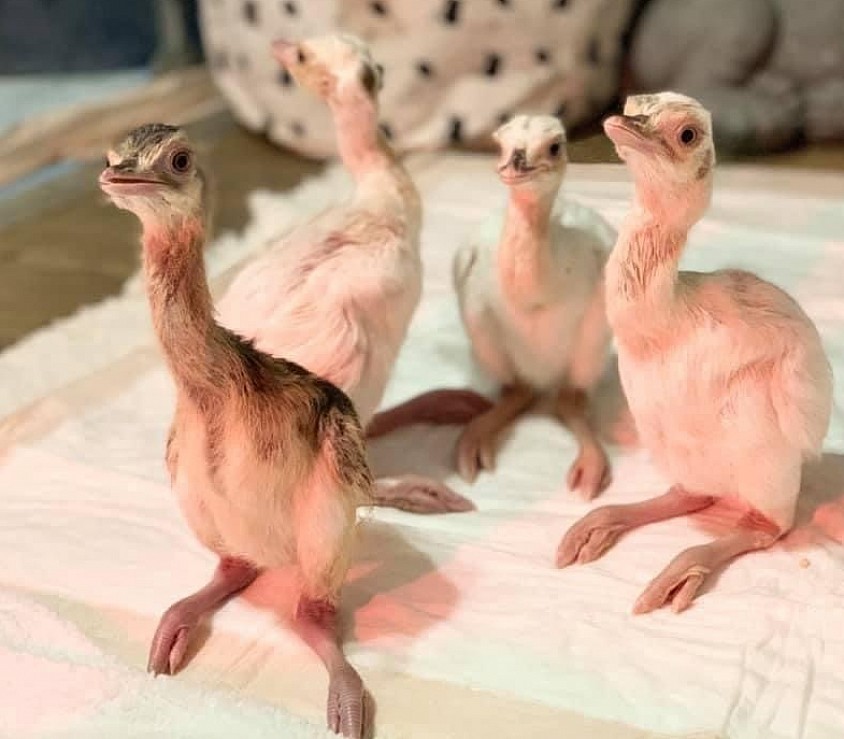
Rhea chicks can be extremely fragile during their first weeks of life. Hatching successfully does not always mean that a chick will automatically thrive.
Young chicks require close observation, suitable warmth, good footing, proper nutrition, companionship, and encouragement to eat and drink.
Some of the problems we have personally encountered or observed include:
● Fading chicks
● Chicks that are difficult to get thriving
● Failure to eat or drink
● Slipped tendons
● Weakness
● Vitamin deficiencies
● Poor leg development
● Difficulty standing or walking
● Sudden decline without many early warning signs
Small concerns should be taken seriously because a fragile chick can decline quickly.
Fading and Hard-to-Thrive Chicks
Some chicks hatch appearing normal but begin to fade over the following hours or days. Others remain active but fail to gain strength, eat consistently, or develop at the same rate as their hatchmates.
Warning signs may include:
● Sleeping more than the other chicks
● Separating from companions
● Weak or unsteady walking
● Little interest in food or water
● Failure to gain weight
● Drooping the head
● Repeatedly lying down
● Quietness
● Changes in droppings
● Becoming chilled easily
A chick that is not eating, drinking, gaining strength, or keeping up with the others needs immediate attention.
Slipped Tendons and Leg Problems
Leg problems can develop quickly in young rheas because they grow at such a fast rate.
Slipped tendons, weak legs, vitamin deficiencies, poor footing, incorrect nutrition, and a lack of exercise can all affect a chick’s ability to stand and walk normally.
Chicks should be kept on flooring that provides good traction. Slick surfaces can make it difficult for them to keep their legs correctly positioned.
Watch carefully for:
● A leg turning outward
● A chick walking abnormally
● Swelling around a joint
● One leg appearing weaker than the other
● Toes curling
● Repeated slipping
● Sitting more than normal
● Walking on the hocks
● Difficulty getting upright
Leg and tendon problems are much easier to address when noticed early. Waiting can allow the chick to grow while continuing to place its weight incorrectly.
Vitamin Deficiencies
Rhea chicks grow rapidly and require carefully balanced nutrition. Vitamin or mineral deficiencies can show up as weakness, leg problems, curled toes, poor growth, neurological symptoms, or failure to thrive.
We have found that rhea chicks need a higher-protein feeding program than emu chicks. Feeding them as though they are emus may not provide the nutritional support needed for healthy rhea growth.
Treats should never replace a balanced ration. Any supplements should be used carefully because too much of certain vitamins or minerals can also cause problems.
Rhea Chick Care Continued…
Rhea Chicks Should Not Be Raised Alone
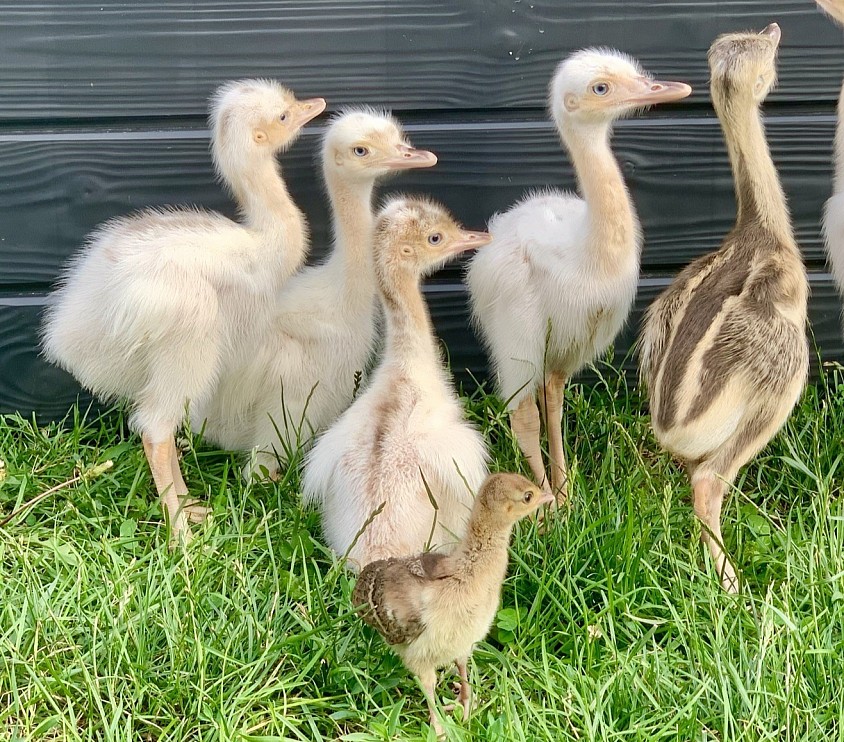
In our experience, rhea chicks do not do well when raised by themselves.
They are social birds and benefit from having another chick with them. A lone chick may become stressed, call constantly, lose interest in eating, or fail to thrive.
Whenever possible, rhea chicks should be raised with another rhea chick of a similar age.
When another rhea chick is not available, adding a chicken chick as a temporary companion can be extremely helpful. The chicken chick’s natural activity can encourage the rhea to follow along and copy its behavior.
A chicken chick can help remind a young rhea to:
● Eat
● Drink
● Move around
● Explore
● Rest comfortably with a companion
The companion should be healthy, appropriately sized, and closely supervised. It should not be aggressive or allowed to pick at the rhea chick.
The chicken chick is not a permanent replacement for companionship with another rhea, but it can be a valuable tool during the delicate early stage when a rhea chick might otherwise be alone.
Teaching a Rhea Chick to Eat and Drink
Do not assume that every newly hatched rhea chick will immediately understand how to eat and drink.
Some chicks need encouragement, especially when they do not have another rhea nearby to copy.
Ways we encourage chicks include:
● Tapping near the feed with a finger
● Using shallow, easy-to-see dishes
● Placing feed directly in front of the chick
● Watching to confirm that the chick actually swallows
● Providing a healthy chicken chick or another rhea as a companion
● Frequently returning the chick to the food and water area
A companion chick often becomes the best teacher. When the chicken chick pecks at food or drinks, the rhea frequently begins copying it.
Owners should personally observe each chick eating and drinking. Feed disappearing from the dish does not prove that every chick in the brooder is consuming enough.
Our Most Important Advice
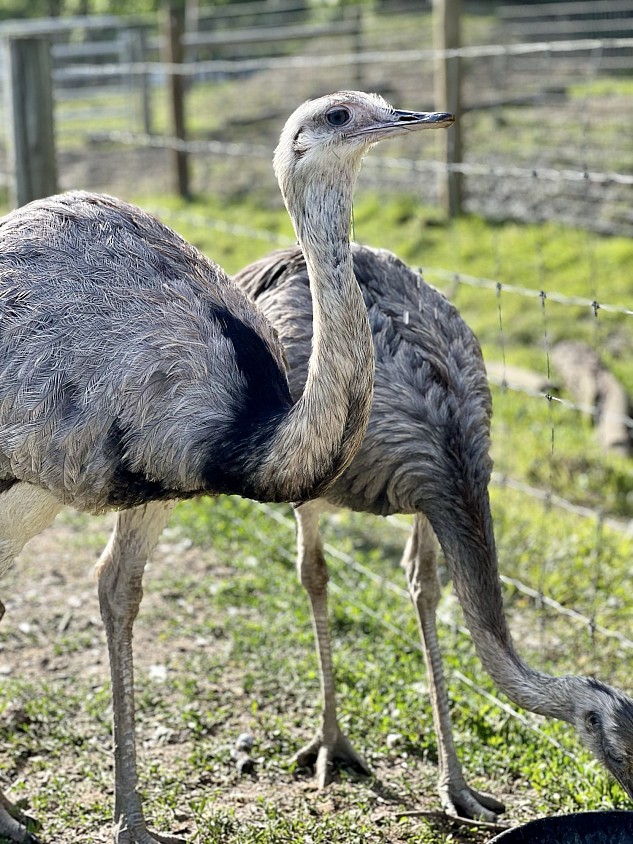
Rheas are rewarding birds, but they are not easy birds to raise successfully.
Adults need space, secure fencing, appropriate nutrition, companionship, and an owner who respects their behavior. Chicks require even more careful management because they can be fragile and decline quickly.
The information on this website comes from our time of raising rheas. We are sharing the methods, observations, challenges, and lessons that have worked for us so that other owners have a practical place to begin.
We will continue adding information as we document our flock, hatching methods, feeding program, chick development, breeding behavior, and the lessons we have learned along the way.
